
How Wi-Fi 8 Aims to Make Your Network More Reliable
 Ryan


How WiFi 8 Aims to Make Your Network More Reliable
As homes add more connected devices, reliable Wi‑Fi becomes increasingly important. Whether you're moving between rooms on a video call, gaming while multiple devices are streaming, or trying to stay connected in areas with weaker coverage, network consistency matters.
WiFi 8 is designed to deliver more consistent connectivity, better capacity management, and dependable coverage throughout the home.
Join us at TP-Link’s Wi-Fi 8 Launch Event
Explore the new and exciting ways Wi-Fi 8 improves your home network, starting with a peek into some of its key features.
What Is Wi-Fi 8?
Unlike previous Wi‑Fi generations that primarily focused on increasing speed, Wi‑Fi 8 focuses on improving reliability, helping devices stay connected, responsive, and efficient even in busy networks with many connected devices.
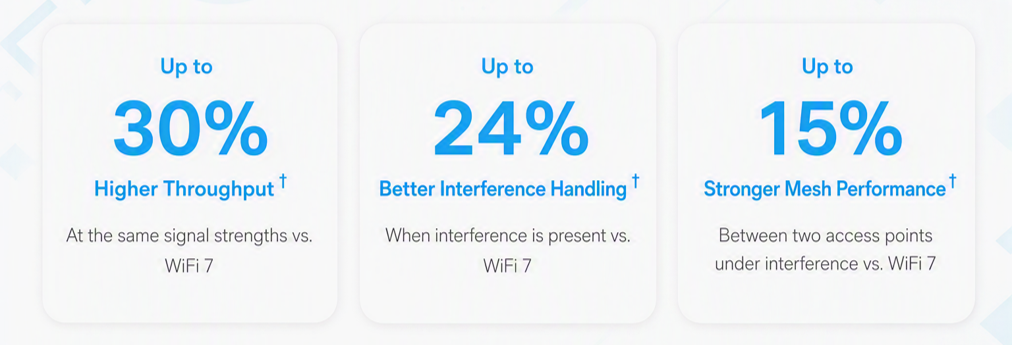
How Will Your Home Network Benefit from Wi‑Fi 8?
Reduces Slowdowns on Busy Home Networks: With phones, laptops, gaming consoles, wearables, and smart home devices all competing for airtime, today's networks are often crowded.
This added congestion can increase latency, reduce throughput, and cause inconsistent performance, especially in homes with many connected devices. Wi-Fi 8 helps by better managing and navigating congested and high-demand networks – even those with hundreds of devices.
Reduces lag and jitter in calls and games: Real-time applications are highly sensitive to latency and jitter. Wi-Fi 8 uses Dynamic Sub-band Operation (DSO) to allocate bandwidth more precisely and Non-Primary Channel Access (NPCA) to use available secondary sub-channels. Together, they reduce congestion and keep calls, video, and gameplay responsive, even during periods of heavy network activity.
Delivers reliable connectivity and maintains speeds, even at the edge of coverage: Large homes, thick walls, and challenging router placement can create areas with weaker Wi-Fi coverage. With technologies like Enhanced Long Range (ELR) and Distributed Resource Units (DRU), Wi-Fi 8 helps devices stay connected farther from the router, delivering more reliable coverage throughout the home.
Improved Seamless Wi-Fi Roaming helps devices transition smoothly between mesh nodes as you move throughout the home. Wi‑Fi 8 coordinates handoffs so the current node maintains the connection until the next node confirms connectivity, helping minimize interruptions for your devices, using technologies like:
- Coordinated Beamforming (Co-BF): In Wi-Fi 8 mesh networks, multiple nodes work together to direct Wi-Fi signals where they are needed most, improving coverage and device connection quality.
- Coordinated Spatial Reuse (Co SR): Mesh nodes coordinate their wireless activity, allowing more devices to communicate at the same time with less interference.
- Coordinated Time Division Multiple Access (Co TDMA): Mesh nodes coordinate when they transmit data, reducing wireless congestion and improving efficiency in crowded network environments.
Maintains throughput and responsiveness as signal conditions change: Wi‑Fi 8 improves resilience to distance, interference, and changing signal conditions by allowing each Wi‑Fi stream to operate independently at its optimal rate using technologies such as Unequal Modulation (UEQM) and New Modulation and Coding Schemes (New MCS).
Join us at TP-Link’s Wi-Fi 8 Launch Event
Keep an eye on our official forums and subreddit as we approach the new year. Over the next few months, our team will be diving into each of the benefits that Wi-Fi 8 aims to provide and how TP-Link is bringing the technology to your home.
Come Back Next Week for Our Next Article on Wi-Fi 8!
Looking for a More Technical Overview?
Still Have Questions? Check out our Wi-Fi 8 Q&A Megathread:
Related Official Articles: