
Early Access EAP773 | EAP783 v1.1.1 Pre-release Firmware (Update on 4th Nov, 2025)


This Article Applies to:
EAP783 V1, Fully Adapted to Omada SDN Controller v5.14 or above;
EAP773 V1, Fully Adapted to Omada SDN Controller v5.14 or above;
Release Notes:
New Feature/ Enhancement:
- Supported Portal Logout.
- Supported cluster deployment in Local Controller mode (Omada Central doesn’t support).
- Supported RADIUS Proxy(Global View> Server Settings> Radius Proxy Server).
- Supported OWE.
- Supported upgrading firmware through cloud in standalone mode.
- Supported Rate Limit with Portal Authentication.
- Supported disabling HTTP protocol in Standalone mode.
- Supported DHCP Option43.
- Supported multiple Radius servers when using MAC-Based Authentication (Site View Settings>MAC-Based Authentication).
- Added support for configuring NAS ID with WPA-Enterprise encryption.
- Supported DNS Queries (Network Tools>Network Check>DNSLookup).
- Supported DNS Adoption.
- Supported configuring the Device Name in Controller mode.
- Supported viewing status information and simple configuration through standalone management page when devices managed by the Controller.
- Supported displaying the maximum associated clients range in Controller mode(EAP Config>Advanced>Load Balance).
- Supported displaying the bandwidth of the EAP in Controller mode.
- Added Support for 11 a/n mixed mode for 5GHz radio in Controller mode.
- Supported multicast and broadcast data statistics.
- Supported disabling HTTP, HTTPS and APP discovery in Controller mode (Only with Pro controller).
- Supported Non-stick Roaming function.
- Supported authentication type of EKMS and Generic Radius with Unbound MAC for PPSK with Radius.
- Supports 1024 PPSK entries.
- Supported Multicast Filtering with IPv6 address.
- Supported Multicast/Broadcast Rate Limit
- Supported displaying Configuration Result.
- Optimized roaming function.
- Optimized Automatic Power Optimization function.
- Optimized the configuration of Beacon Interval.
- Optimized Portal Function.
- Optimized MLO connection stability.
- Improved Device and Network security.
- Improved time to configure SSID.
- Improved stability.
Bug Fixed:
- Fixed the issue that RSSI display error in WLAN Optimization.
- Fixed the issue that URL Filtering cannot work properly after TLS1.3 is enabled in the browser.
- Fixed the issue that HTTPS Redirection and Pre-Authentication Access don’t take effect when use portal.
- Fixed the issue that IPv4 multicast packets can’t be transmitted from mesh AP to root AP.
- Fixed the issue that one hop mesh AP’s client on SSID with VLAN would have slow Network speed.
- Fixed the issue that CoA doesn’t take effect with some MLO clients.
Pre-release Firmware Download
Attention
Please be sure you have read the Beta Test Agreement before upgrading the Beta firmware!
EAP783_V1_1.1.1_20251103 (Pre-release)
EAP773_V1_1.1.1_20250818 (Pre-release)
EAP783_V1_1.1.1_20250818 (Pre-release)
Notes:
(1) The above firmware is applied to EAP783 V1.
(2) Your device’s configuration won’t be lost after upgrading.
(3) The above firmware is fully adapted to Omada SDN Controller v5.14 and above
Update Log
4th Nov, 2025
Provide the pre-release link for EAP783
EAP783_V1_1.1.1_20251103 (Pre-release)
31th Oct, 2025
Remove the download links.
19th Aug, 2025
Provide the following pre-release link:
EAP773_V1_1.1.1_20250818 (Pre-release)
EAP783_V1_1.1.1_20250818 (Pre-release)
19th Aug, 2025
Update the release note.
Feedback
Any further feedback on the new firmware, please feel free to comment below or start a new thread from HERE.
To get better assistance, you may check Tips For Efficiently Reporting an Issue In The Community.
When reporting an issue, especially it's about firmware upgrade, it's suggested to include the following info:
- Management mode (Controller or Standalone)
- Device Model(s) and Hardware
- Device Firmware (previous and current)
Thank you in advance for your great cooperation and support.
Recommended Threads
Experience the Latest Omada EAP Firmware - Trial Available Here, Subscribe for Updates!
Current Available Solutions to Omada EAP Related Issues [Constantly Updated]
Get the Latest Omada SDN Controller Releases Here - Subscribe for Updates
- Copy Link
- Subscribe
- Bookmark
- Report Inappropriate Content

@Vincent-TP, I'm experiencing crashes on MLO while using an iPhone 16 Pro (which has since been disabled), and drop outs on non-MLO ever since upgrading from an EAP660 HD to this EAP783. I'd like to try this pre-release firmware to see if things have improved.
However, I may be on hardware version 1.6 -- while the label on the device says "US/1.6" next to the model number, the dashboard on the device itself says "hardware version: 1.0". Will there be a pre-release firmware compatible with hardware v1.6?
Thanks.
- Copy Link
- Report Inappropriate Content
Thanks for the feedback.
Please enable the following roaming features(site settings)
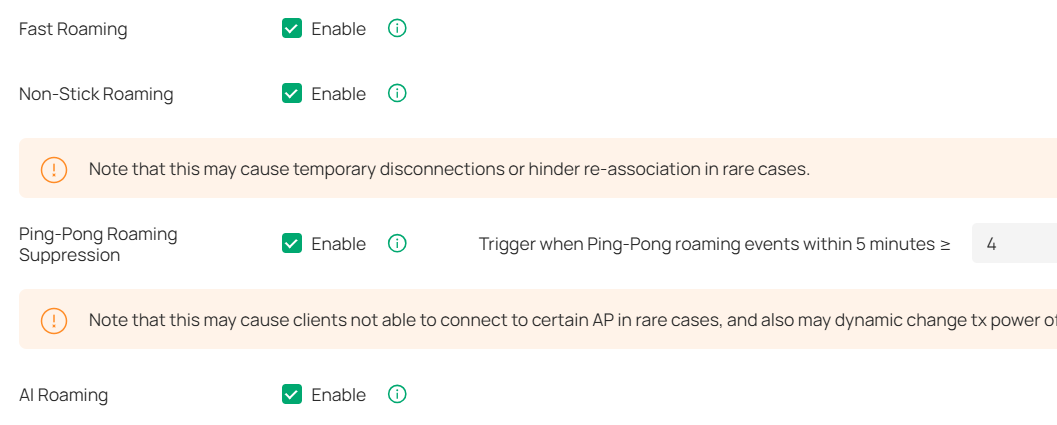
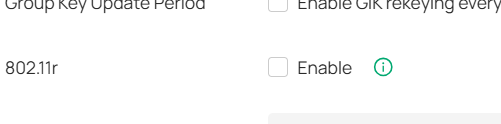
And uncheck 802.11r. (SSID advanced settings)
MrAdministrator wrote
I've had a couple of device disconnects, not just phone but also laptop.
At least one of them I checked with the logs and it occured when roaming from one AP to another, both EAP 783's on 1.1.1. Both phone and laptop disconnected at the same time (the log showed them both switching AP's roaming at the same time)
- Copy Link
- Report Inappropriate Content
I've had a couple of device disconnects, not just phone but also laptop.
At least one of them I checked with the logs and it occured when roaming from one AP to another, both EAP 783's on 1.1.1. Both phone and laptop disconnected at the same time (the log showed them both switching AP's roaming at the same time)
- Copy Link
- Report Inappropriate Content
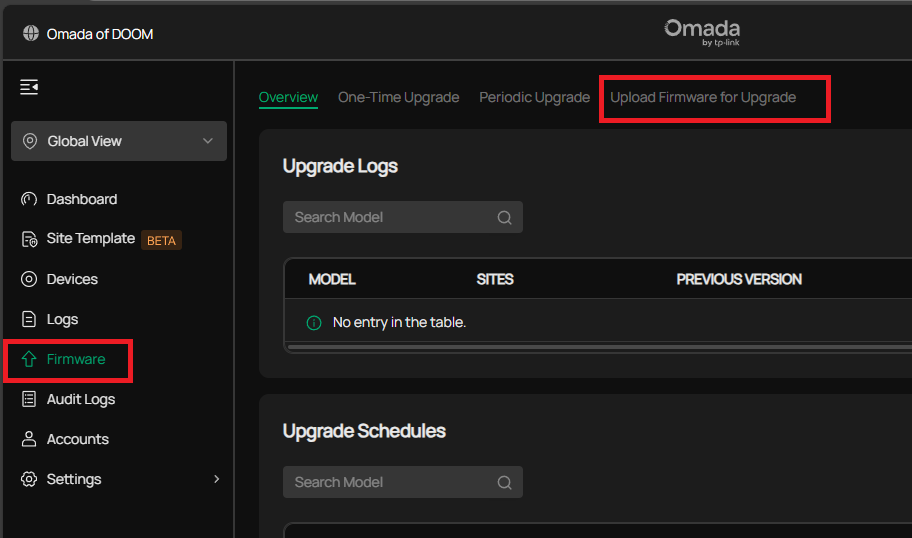
This is the one that said the file size is too large. I've been using this feature to upload every variant of this beta that support has sent until now, several versions.
This is the only one with a file size so large it refused.
- Copy Link
- Report Inappropriate Content
- Copy Link
- Report Inappropriate Content

Hi @Vincent-TP
Thank you very much for your prompt and detailed response.
As I mentioned earlier, at the moment I only have one Wi-Fi 7 capable device (the iPhone 16), so unfortunately I cannot verify the behavior with other devices.
In any case, I now understand that this is not an AP-side issue but rather related to the iPhone’s own connection algorithm.
Thanks again for your support.
- Copy Link
- Report Inappropriate Content
Hi @JIN_JPN
Thanks for the sharing.
Whether a device connects via single-band or multi-band depends largely on the smartphone itself.
Based on our previous tests:
- Apple devices sometimes connect via 5GHz+6GHz (multi-band), other times via single-band – we haven't yet determined the exact pattern or conditions.
- Comparative testing with other vendors' APs showed that even the iPhone 16 Pro Max typically connects via single-band.
Suggestions:
- Continue observing your device's connection behavior over time.
- Test with other WiFi 7-capable devices if possible, maybe your friends' phone (e.g., as mentioned in the FAQ, the Xiaomi 13 Pro was used for testing).
JIN_JPN wrote
Hello,
I am currently using EAP783 with firmware v1.1.1 Pre-release.
This issue has been present even before updating to this firmware.When I enable MLO on the SSID and connect with an iPhone 16 (Wi-Fi 7 supported), the device only connects via 11be (6 GHz).
According to the following TP-Link FAQ page, if a client properly supports MLO, it should appear as something like 11be (2.4 GHz) + 11be (6 GHz). However, I do not see such behavior on my setup.
FAQ reference: https://www.tp-link.com/cz/support/faq/4019/?app=t
At the moment, I only have one Wi-Fi 7 capable device (the iPhone 16), so I cannot test this with other clients.
I have attached screenshots of the SSID settings page and the clients page for reference. Please note that the iPhone 16 is definitely connected to the SSID with MLO enabled.
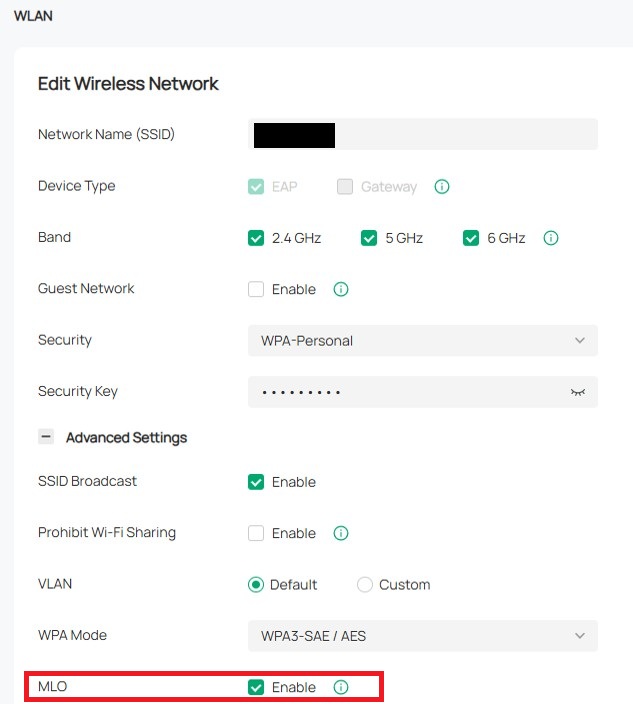

Are there any known limitations or requirements for enabling MLO with EAP783 and iPhone 16?
Thank you in advance for your support.
- Copy Link
- Report Inappropriate Content
Hello,
I am currently using EAP783 with firmware v1.1.1 Pre-release.
This issue has been present even before updating to this firmware.
When I enable MLO on the SSID and connect with an iPhone 16 (Wi-Fi 7 supported), the device only connects via 11be (6 GHz).
According to the following TP-Link FAQ page, if a client properly supports MLO, it should appear as something like 11be (2.4 GHz) + 11be (6 GHz). However, I do not see such behavior on my setup.
FAQ reference: https://www.tp-link.com/cz/support/faq/4019/?app=t
At the moment, I only have one Wi-Fi 7 capable device (the iPhone 16), so I cannot test this with other clients.
I have attached screenshots of the SSID settings page and the clients page for reference. Please note that the iPhone 16 is definitely connected to the SSID with MLO enabled.
Are there any known limitations or requirements for enabling MLO with EAP783 and iPhone 16?
Thank you in advance for your support.
- Copy Link
- Report Inappropriate Content
Which page did you try?
One-Time Upgrade or Upload Firmware for Upgrade?
I believe it's because this is not an official firmware.
MrAdministrator wrote
Uploaded directly to the device and it worked.
Seems weird the Firmware management feature has an arbitrary file size limitation?
- Copy Link
- Report Inappropriate Content
Uploaded directly to the device and it worked.
Seems weird the Firmware management feature has an arbitrary file size limitation?
- Copy Link
- Report Inappropriate Content
Information
Helpful: 0
Views: 12786
Replies: 104
Voters 0
No one has voted for it yet.