
Early Access EAP772v1 EAP773v1 EAP783v1 Adapted to Omada 6.1 Pre-release Firmware (Released on 14th Jan 2026)


This Article Applies To:
EAP772 V1, Fully Adapted to Omada SDN Controller v6.1 or above;
EAP773 V1, Fully Adapted to Omada SDN Controller v6.1 or above;
EAP783 V1, Fully Adapted to Omada SDN Controller v6.1 or above;
Note
To update to this pre-release version, please make sure your device version is not lower than the version listed below:
EAP772 V1: 1.1.2 and above
EAP773 V1: 1.1.2 and above
EAP783 V1: 1.1.2 and above;
Release Notes:
New Feature/ Enhancement:
1. Optimized configuration synchronization mechanism.
2. Optimized automatic adoption.
3. Optimized ACS mechanism.
4. Optimized DFS switching mechanism and radar wave conflict handling.
5. Optimized automatic bandwidth selection mechanism.
6. Optimized background scanning mechanism.
7. Optimized VLAN implementation mechanism.
8. Optimized the Log reporting mechanism, adding logs related to DFS, CPU utilization, and more.
9. Optimized PPSK configuration process. Configuring a PPSK profile will only affect the modified entries.
10. Optimized FDB table management mechanism.
11. Optimized CoA-ACK/NAK message cache mechanism.
12. Supported secure firmware download strategy.
13. Supported configuration of WPA3 Enterprise on the Standalone page.
14. Supported configuration of DNS adoption switch (Remote Adoption) on the Standalone page.
15. Modified the default security policy of SSIDs in factory state.
16. Modified the verification rules for static IP configuration items on the Standalone page.
17. Solved the problem of redirection and adoption failure of devices in the management state in the NAT scenario.
18. Solved the Blast-RADIUS security vulnerability and added a message-authenticator attribute verification switch.
Beta Firmware Download
Attention
Please be sure you have read the Beta Test Agreement before upgrading the Beta firmware!
EAP772 v1.0_1.2.0_20260113-rel72533 (Pre-release Version)
EAP773 v1.0_1.2.0_20260113-rel72533 (Pre-release Version)
EAP783 v1.0_1.2.0_20260113-rel72533 (Pre-release Version)
Notes:
(1) Your device’s configuration won’t be lost after upgrading.
(2) The above firmware is fully adapted to Omada SDN Controller v6.1 and above
(3) This pre-release firmware can be applied to all versions (EU/US/AU/CA/etc).
Update Log
14th Jan, 2026
Provide the pre-release link:
EAP772 v1.0_1.2.0_20260113-rel72533 (Pre-release Version)
EAP773 v1.0_1.2.0_20260113-rel72533 (Pre-release Version)
EAP783 v1.0_1.2.0_20260113-rel72533 (Pre-release Version)
Feedback
Any further feedback on the new firmware, please feel free to comment below or start a new thread from HERE.
To get better assistance, you may check Tips For Efficiently Reporting an Issue In The Community.
When reporting an issue, especially it's about a firmware upgrade, it's suggested to include the following info:
- Management mode (Controller or Standalone)
- Device Model(s) and Hardware
- Device Firmware (previous and current)
Thank you in advance for your great cooperation and support.
Recommended Threads
Experience the Latest Omada EAP Firmware - Trial Available Here, Subscribe for Updates!
Current Available Solutions to Omada EAP Related Issues [Constantly Updated]
Get the Latest Omada SDN Controller Releases Here - Subscribe for Updates
- Copy Link
- Subscribe
- Bookmark
- Report Inappropriate Content

@Vincent-TP
You're directly contradicting what @Hank21 stated here: https://community.tp-link.com/en/business/forum/topic/663452?replyId=1350934
The 22dBm broadcast beacon is due to the lack of AFC, so the radio is not permitted to broadcast at full power.
In addition, the datasheet for the EAP783 states the 6GHz antenna gain is 5dBm, not 6.
Lastly, this problem is not new, the EAP783 has behaved this way since it was released.
Vincent-TP wrote
The 28 dBm you set is the EIRP (Equivalent Isotropically Radiated Power), which is the final transmit power limited by regulations. The 22 dBm displayed on this page is the actual RF power. The difference of about 6 dB mainly comes from the gain of the EAP783’s built-in antenna (approximately 6 dBi). The calculation formula is: EIRP = actual RF power + antenna gain. Therefore, the actual power of 22 dBm plus the 6 dBi antenna gain exactly achieves your set target of 28 dBm EIRP. This is completely normal and not a malfunction.
This change was introduced in a recent firmware update, and we will explain this situation in the release notes going forward. Thank you all for your attention.
- Copy Link
- Report Inappropriate Content

Sounds like the best answer is to enable AFC in the firmware. Do you have a ETA?
MrAdministrator wrote
@Vincent-TP
You're directly contradicting what @Hank21 stated here: https://community.tp-link.com/en/business/forum/topic/663452?replyId=1350934
The 22dBm broadcast beacon is due to the lack of AFC, so the radio is not permitted to broadcast at full power.
In addition, the datasheet for the EAP783 states the 6GHz antenna gain is 5dBm, not 6.
Lastly, this problem is not new, the EAP783 has behaved this way since it was released.
Vincent-TP wrote
The 28 dBm you set is the EIRP (Equivalent Isotropically Radiated Power), which is the final transmit power limited by regulations. The 22 dBm displayed on this page is the actual RF power. The difference of about 6 dB mainly comes from the gain of the EAP783’s built-in antenna (approximately 6 dBi). The calculation formula is: EIRP = actual RF power + antenna gain. Therefore, the actual power of 22 dBm plus the 6 dBi antenna gain exactly achieves your set target of 28 dBm EIRP. This is completely normal and not a malfunction.
This change was introduced in a recent firmware update, and we will explain this situation in the release notes going forward. Thank you all for your attention.
- Copy Link
- Report Inappropriate Content

Is anyone else experiencing the slow 2,4ghz speeds with this firmware?
- Copy Link
- Report Inappropriate Content
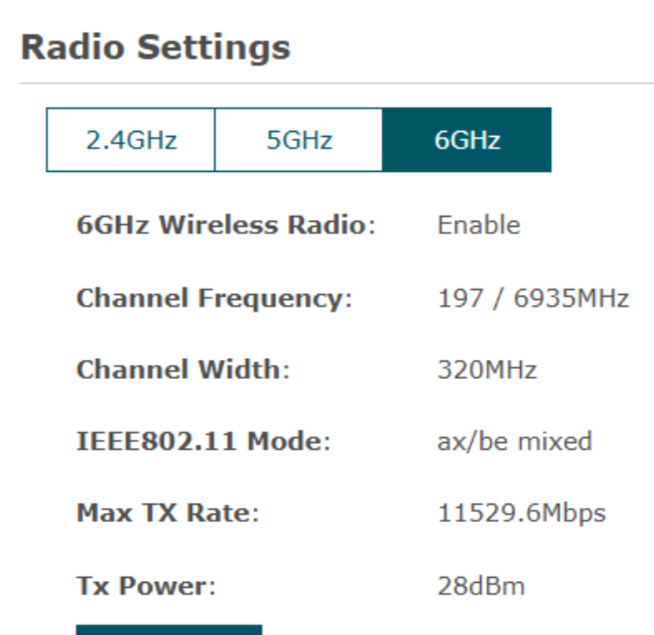
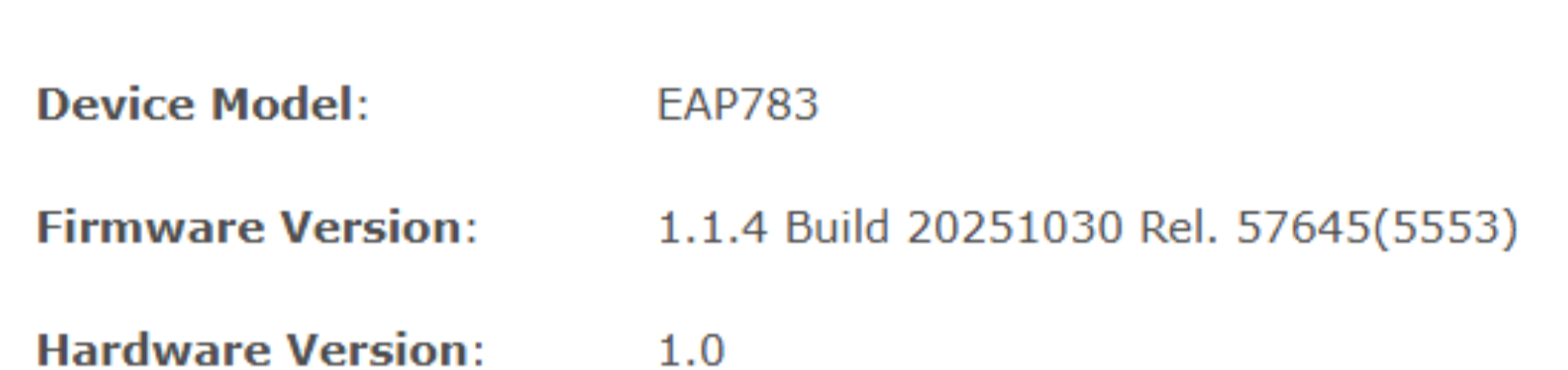
My apologies, what I mentioned yesterday was slightly inaccurate. The 6 dBi is not antenna gain, but MIMO gain. The MIMO gain is 6 dBi. This change was indeed introduced recently, and previous versions did not display it this way. Here is a screenshot from our earlier version.
MrAdministrator wrote
@Vincent-TP
You're directly contradicting what @Hank21 stated here: https://community.tp-link.com/en/business/forum/topic/663452?replyId=1350934
The 22dBm broadcast beacon is due to the lack of AFC, so the radio is not permitted to broadcast at full power.
In addition, the datasheet for the EAP783 states the 6GHz antenna gain is 5dBm, not 6.
Lastly, this problem is not new, the EAP783 has behaved this way since it was released.
Vincent-TP wrote
The 28 dBm you set is the EIRP (Equivalent Isotropically Radiated Power), which is the final transmit power limited by regulations. The 22 dBm displayed on this page is the actual RF power. The difference of about 6 dB mainly comes from the gain of the EAP783’s built-in antenna (approximately 6 dBi). The calculation formula is: EIRP = actual RF power + antenna gain. Therefore, the actual power of 22 dBm plus the 6 dBi antenna gain exactly achieves your set target of 28 dBm EIRP. This is completely normal and not a malfunction.
This change was introduced in a recent firmware update, and we will explain this situation in the release notes going forward. Thank you all for your attention.
- Copy Link
- Report Inappropriate Content
Hi @nikisima
The speed you described, 70-110 Mbps on 2.4GHz Wi-Fi, is lower than expected but still within a common range, not entirely abnormal.
There are two main reasons:
- Low Physical Limit: Under typical configurations (20MHz bandwidth and 2x2 MIMO), the theoretical maximum speed for 2.4GHz is only about 144Mbps. Achieving 50%-75% of that in real-world use is considered decent.
- Interference is the Key Bottleneck: An “excellent” signal strength indicates strong signal power, not high signal quality. The 2.4GHz band is congested and highly susceptible to interference from neighboring Wi-Fi networks, Bluetooth devices, and household appliances. In such a high-interference environment, despite strong signal strength, data transmission requires frequent error correction and retransmission, severely dragging down the effective speed.
RSSI vs. SNR: What Really Determines Your Wi-Fi Speed?
For 2.4GHz Wi-Fi, achieving a stable throughput of 70-110 Mbps in real-world home environments is an acceptable result, especially as it is entirely sufficient for applications such as connecting smart home devices and web browsing.
nikisima wrote
2.4 Wi-Fi is super slow with this firmware for me on my 783. I only get around 70-110Mbit with excellent signal.
Has anyone tested MLO yet with iPhones, Pixel and Samsung devices? Any issues?
I see a similar thing on 5ghz, it is set to 30dBm but only shows 23dBm.
- Copy Link
- Report Inappropriate Content
I see that EAP773 V1 firmware version EAP773(US)_V1_1.1.5 Build 20251230 has been released, is now generally available. It appears that this prerelease firmware is newer, V1.2.0. I assume if we already installed V1.2.0 we should stick with that until it or a newer version is released vs installing the generally available firmware 1.1.5?
- Copy Link
- Report Inappropriate Content
Hi @eap-oma
Yes, this version is newer. You can keep using this firmware to experience the new features.
eap-oma wrote
I see that EAP773 V1 firmware version EAP773(US)_V1_1.1.5 Build 20251230 has been released, is now generally available. It appears that this prerelease firmware is newer, V1.2.0. I assume if we already installed V1.2.0 we should stick with that until it or a newer version is released vs installing the generally available firmware 1.1.5?
- Copy Link
- Report Inappropriate Content
>Sounds like the best answer is to enable AFC in the firmware. Do you have a ETA?
I didn't see a response to this. Is it coming anytime soon?
- Copy Link
- Report Inappropriate Content

I'm interested in AFC as well.
- Copy Link
- Report Inappropriate Content
@Vincent-TP
The 2,4ghz tests at ~100mbit are in a single house with no other WiFis nearby and no other clients connected. No Bluetooth or other devices that might disturb the signal. Testing in the same room as the AP.
Before the update, I could almost saturate the gigabit connection, now it won't go over ~100Mbit. 5Ghz works as expected.
Transmit and receive link speed is shown as 286 Mbps on my Pixel 9. It is the same, no matter if I use 20Mhz or 40Mhz (40Mhz shows a Receive Link of 270Mbps).
Can anyone else test this?
- Copy Link
- Report Inappropriate Content
Information
Helpful: 1
Views: 9883
Replies: 50
Voters 0
No one has voted for it yet.