
Omada Linux Controller Configuration Timeout

Omada Linux Controller Configuration Timeout

Omada Linux Controller Configuration Timeout
3 weeks ago - last edited a week ago
Hardware Version: V6
Firmware Version: 6.1.0.19

I am running 62 APs with Omada software controller version 6.1.0.19 (latest i think) on the following hardware:

Intel  Atom D2500 2C2T 1.86Ghz CPU

4G DDR3 RAM

32 GB SATA SSD

1GbE network interface

The RAM usage is at 2GB, Disk has 11 Gb free space and so nothing maxed out normally AND during configuration. System is fast for our use, and is able to happily run additional apps like External Hotspot Portal Server, PiHole, etc. This hardware is low power industrial type (Giada MI-NAS25), but looking at system resource usage data, it DOES NOT appear to be a bottleneck for Omada in any way. 

Today morning, I changed the WLAN Config from North Bound Interface (Cloud Portal) and specifically only the client rate profile parameter which impacts all APs in the Southbound interface. The configuration worked for 53/62 APs but failed for 9 APs. The 9 failed APs all ended up in "DISCONNECTED" state.
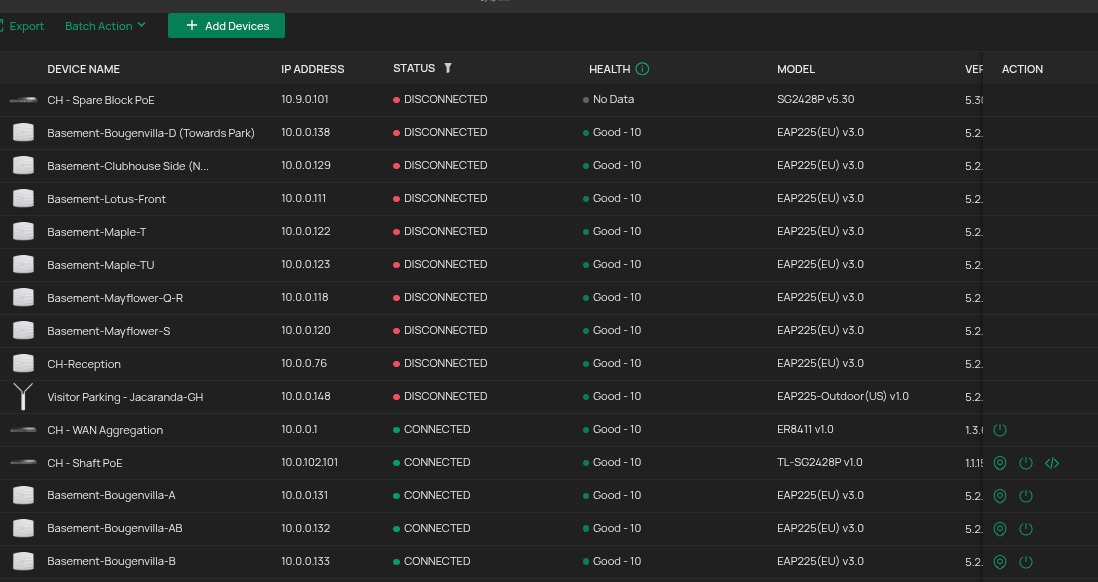


The Checked the config result and it shows Timeout Error Code AP -6
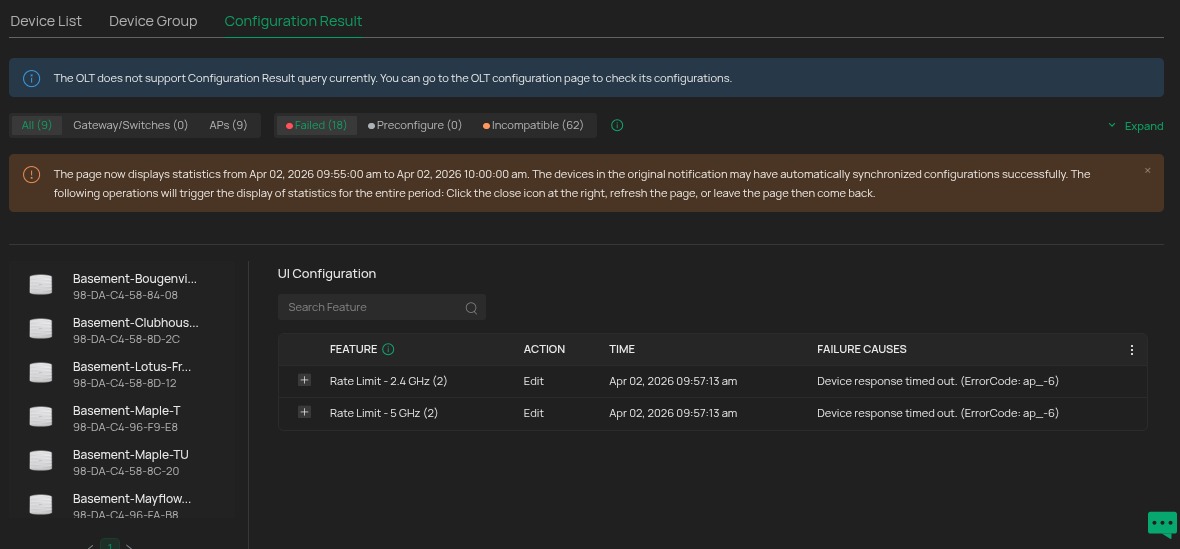


Any pointers to why this could have happened and why its not recovering the APs automatically or I need to wait for some configured time where this AP will retry its registration with controller, get adopted and synced.

I also observed that if I leave the failed APs alone like this (Right now I will not disturb) it will keep flapping states like ADOPTING, ADOPT FAILED, PROVISIONING and DISCONNECTED. Anything except "CONNECTED". I have had this problem since last 3-4 years on this system but unable to shake it off. It only stop once I stop reconfiguring (you get to a stage like that) and then restart the APs using the switch PoE Off/On cycle.

I tried logging in directly to APs in Disconnected state, assuming that they had fallen back to some standby node or will at-least show that AP is being managed by controller. However the Http web page of teh AP does not itself show and it seems the AP is some type of dead loop state with CPU fully busy. So after half a day I restarted the down APs just to bring them back online. The root cause of the issue is still not identified and might repeat any day, if i try to do the config operations again ...



0
0
#1
1 Accepted Solution
Re:Omada Linux Controller Configuration Timeout-Solution
2 weeks ago - last edited a week ago

Hi  @APRC-P3-Tel 


Thanks for posting here.


So, you’re saying your controller has two IP addresses, right? I think you are correct—that is likely the cause of this issue. Every time a configuration change is made for the EAP on the controller, communication between the controller and the EAP is required. Since the controller has two IP addresses, traffic between the EAP and the controller may be routed to two different destinations, which could lead to the phenomenon you’re experiencing.

If these two IP addresses are not specifically required, it is recommended to keep only one.

For your other EAP still experiencing the issue, please swap its position with another EAP for testing to determine whether the problem is related to hardware or the network link.

Recommended Solution
0
0
#3
3 Reply
Re:Omada Linux Controller Configuration Timeout
3 weeks ago - last edited 3 weeks ago

  @APRC-P3-Tel : This time we made some progress with this problem. WE had two Physical network interfaces and 2 IP address configured on this system. But only one cable connected. The system was reachable at both IPs even if only one cable was connected. When I disabled the 2nd network interface and teh 2nd IP using nmtui utility, the problem drastically reduced. Now I am getting this AP Configuration timeout with just one AP, if I make a configuration change which impacts all APs on teh southbound interface. And this AP is a repeat candidate consistently.

Also I feel that disabling teh 2nd IP and interface, caused both the web application and Omada Mobile App (android version to speed up). So maybe their are some issues if the host running omada controller is multi-homed and both interfaces are connected to the same subnet

0
0
#2
Re:Omada Linux Controller Configuration Timeout-Solution
2 weeks ago - last edited a week ago

Hi  @APRC-P3-Tel 


Thanks for posting here.


So, you’re saying your controller has two IP addresses, right? I think you are correct—that is likely the cause of this issue. Every time a configuration change is made for the EAP on the controller, communication between the controller and the EAP is required. Since the controller has two IP addresses, traffic between the EAP and the controller may be routed to two different destinations, which could lead to the phenomenon you’re experiencing.

If these two IP addresses are not specifically required, it is recommended to keep only one.

For your other EAP still experiencing the issue, please swap its position with another EAP for testing to determine whether the problem is related to hardware or the network link.

Recommended Solution
0
0
#3
Re:Omada Linux Controller Configuration Timeout
2 weeks ago

  @Vincent-TP : I have done exactly this and I am absolutely fine with this. The controller is not in the main flow (routing) and therefore it does not need anything more than 1000 mbps for upgrades and configurations. Even 100 mbps maybe fine if its done in batches.

I just hope their is no problem, if we use the 2nd interface on another subnet (like directly connected to Public Internet). I have a use case where , I want to do this for an external portal running on same machine and which has a self service portal (for resting and email/SMS passwords as an example).
 

Vincent-TP wrote

Hi  @APRC-P3-Tel 


Thanks for posting here.


So, you’re saying your controller has two IP addresses, right? I think you are correct—that is likely the cause of this issue. Every time a configuration change is made for the EAP on the controller, communication between the controller and the EAP is required. Since the controller has two IP addresses, traffic between the EAP and the controller may be routed to two different destinations, which could lead to the phenomenon you’re experiencing.

If these two IP addresses are not specifically required, it is recommended to keep only one.

For your other EAP still experiencing the issue, please swap its position with another EAP for testing to determine whether the problem is related to hardware or the network link.


0
0
#4