
Hardware/firmware requirement for wifi calling feature

Hey there,
tp-link just released wifi calling feature on Omada devices this week. Does it have any any requirements on hardware/firmware?
Thank you!
- Copy Link
- Subscribe
- Bookmark
- Report Inappropriate Content


@mma678 Per the FAQ, it just requires that the specific EAPs are compatible with Omada Controller V6.2
How to use Wi-Fi Calling in your Omada Ecosystem | Omada Network Support
- Copy Link
- Report Inappropriate Content
@mma678 Per the FAQ, it just requires that the specific EAPs are compatible with Omada Controller V6.2
How to use Wi-Fi Calling in your Omada Ecosystem | Omada Network Support
- Copy Link
- Report Inappropriate Content
@NeilR_M Care to advise which EAPs are compatible with Omada controller v6.2? Do my EAP670 or EAP660HP meet the requirements? I have already updated their FW to the latest one.
- Copy Link
- Report Inappropriate Content
@mma678 It would be on a device by device basis, but as far as I could tell I don't see explicit compatibility with V6.2 just yet; you may need to wait for a firmware update for your devices.
I do see that the EAP7xx series devices just added Wi-Fi calling support through Pre-release firmware so you may need to wait for a specific release for your devices as well.
- Copy Link
- Report Inappropriate Content

@NeilR_M What is the WiFi calling enhancement added to Omada / EAP?
I've been running WiFi Calling at StarLink connected for a couple years. It works! But it can drop without notice... POOF especially when the phone is "roaming" between EAP's.
Wi‑Fi Calling does not require any special “WiFi‑calling‑compatible” access point or mesh system. What it does require is that the AP/mesh provide the network conditions that allow the phone to maintain a stable, low‑latency, low‑jitter IPsec tunnel to the carrier’s ePDG.
Wi‑Fi Calling traffic must be prioritized as WMM Voice. Enterprise guidance explicitly calls out WMM/DSCP/PCP mapping as essential for voice quality. Some systems allow defining ePDG domains and prioritizing Wi‑Fi Calling traffic explicitly. Does Omada support per‑carrier Wi‑Fi Calling profiles with priority set to “Voice"? Omada cannot identify the IPsec tunnel endpoints and mark them as voice. In my scenario, people have phones from different carriers... can have over 100 registered smartphones on the system. Wi-Fi Calling traffic can be prioritized with WMM/802.11e on any SSID if the network identifies the traffic. This is the part that will take some work by inspecting IP/UDP ports or DSCP markings to segregate from other multi-media traffic.
I'm not using 802.11r Fast Roaming. Found it causes trouble with some devices. For a private condo building scenario, we are only WPA2 authentication, so only have k and v roaming lists enabled. Maybe this is the issue, since Mesh or multi‑AP systems must avoid long re‑authentication pauses. Enterprise voice guides emphasize minimizing roaming delay to prevent jitter and packet loss. 802.11r may still help WPA2 or 3 authentication speed, but is not optional for enterprise level authentication.
So what is the WiFi calling enhancement added to Omada / EAP?
RF Dude
- Copy Link
- Report Inappropriate Content
@RF_Dude The Wi-Fi calling enhancement just refers to the Wi-Fi calling profile creation and use described in the FAQ. In your scenario, how many profiles would you need to make for the stated number of smartphones? Presumably, even if there are that many devices, there must be some overlap of carriers.
If you can include as much information as possible about your use case, that would help any feedback land more effectively with the development team.
- Copy Link
- Report Inappropriate Content
@NeilR_M Thank you for your response and invite for more info.
My most needy site for WiFi Calling is in a remote area of Ontario, Canada at an MDU & club with 11 AP's and 2 SL terminals feeding an ER7206 v1 over SFP WAN and WAN ports. Load balance 1:1, application optimized. A common private SSID exists for members, as well as an open Guest SSID with client isolation and an IoT SSID.
Your FAQ suggests essentially domain‑based QoS classification. It’s a convenience layer on top of DSCP/WMM. It seems this improves uplink/downlink prioritization for the IPsec tunnel carrying the Wi‑Fi call. It is a welcome improvement.
You could confirm if the following features would serve WiFi calling best within present capabilities:
-
802.11r: ON
-
802.11k: ON
-
802.11v: ON
-
Band Steering: Prefer 5 GHz (or 6 GHz)
-
Minimum RSSI: ‑70 dBm (5 GHz)
-
Minimum Data Rate: 12 Mbps
-
DTIM: 3
-
Load Balancing: ON with Application Optimized Routing mandatory
-
Airtime Fairness: OFF
-
Client Isolation: OFF
-
Wi‑Fi Calling Profiles: All carriers, Priority = Voice
If there is one additional improvement to add, it would be: Wi-Fi Calling-aware roaming optimization. Now that domain-based Wi-Fi Calling QoS/profiles are being added, please extend those profiles to also drive roaming decisions (802.11k/v/r + AI Roaming). Specifically, apply voice-optimized parameters (lower roam threshold, forced BSS transition, faster neighbor reports) for any client matching an ePDG domain. This would prevent sticky-client behavior and call drops during AP handoffs. If you implement it, this would put Omada ahead of most prosumer systems for VoWiFi reliability.
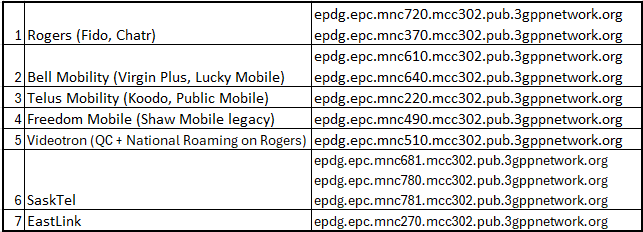
This is the Canadian carrier ePDG list, vetted through three AI engines...CoPilot, Gemini and Grok... for everyone's convenience. The first 4 would be more common, with the last 3 being regional. Sorry... I had to attach as a graphic, as the table I attempted to insert was CENSORED! "The following sensitive language has been used which goes against the rules of the Community: all the epdg URL's!!!
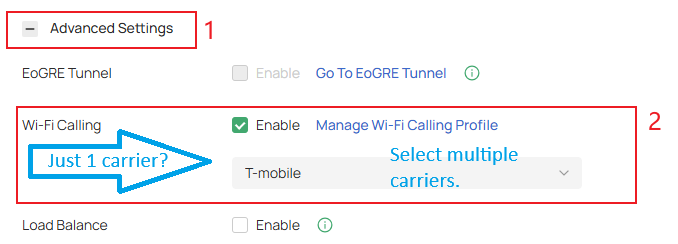
Below graphic in your FAQ implies there is only one supported carrier. No "add another carrier" button seems to show. Of course, elsewhere in your FAQ, multiple carriers are mentioned with 8 profiles available. Just not evident from this....
- Copy Link
- Report Inappropriate Content

@NeilR_M Is there a roadmap of which EAPs will be getting this feature? e.g., will my EAP-655? Or is this something only for the 7x series or ceiling access points?
- Copy Link
- Report Inappropriate Content
@GoodOmens I unfortunately don't currently have a roadmap of when other devices will be getting this feature, but as an example I do see that the EAP670 is getting an update for controller compatibility some time in Q2, per another post on the community. With that in mind, I have hope it'll get an update, but just keep an eye out for any beta firmware releases for the EAP6XX devices.
- Copy Link
- Report Inappropriate Content

@GoodOmens I was wondering the same thing. I've only looked at a few devices so far but they all list as not supported.
Site >> Devices >> Configuration result
| Wi-Fi Calling Profile |
The device does not support this feature |
On older APs such as EAP225, EAP225-Outdoor, EAP265
- Copy Link
- Report Inappropriate Content

I have several EAP723 V1 & V2 access points and they appear not support Wi-Fi calling:
| Wi-Fi Calling Profile |
The device does not support this feature |
All AP's are running up to date firmware.
From what I have read, the EAP7xx AP's should support this feature. Hoping an update resolves this...
- Copy Link
- Report Inappropriate Content
Information
Helpful: 0
Views: 1619
Replies: 10
Voters 0
No one has voted for it yet.