
Early Access EAP65x | EAP67x Pre-release Firmware Adapted to Omada Controller v6.0 (Closed on 23st Oct, 2025)


This Article Applies To:
EAP670v1 1.3.50 Fully Adapted to Omada SDN Controller v6.0.
EAP650v1 1.3.50 Fully Adapted to Omada SDN Controller v6.0.
EAP670v2 1.3.50 Fully Adapted to Omada SDN Controller v6.0.
EAP673-Extenderv1 1.3.50 Fully Adapted to Omada SDN Controller v6.0.
EAP650-0utdoorv1 13.50 Fully Adapted to Omada SDN Controller v6.0.
EAP673v1 1.3.50 Fully Adapted to Omada SDN Controller v6.0.
EAP650D30-0utdoorv1 1.3.50 Fully Adapted to Omada SDN Controller v6.0.
EAP650D120-0utdoorv1 13.50 Fully Adapted to Omada SDN Controller v6.0.
EAP653v1 1.3.50 Fully Adapted to Omada SDN Controller v6.0.
Release Notes:
1. Supported Omada APs of new VI.
2. Adapted to CE-RED certification.
3. Optimized DFS switching mechanism and radar wave conflict handling.
4. Optimized automatic bandwidth selection mechanism.
5. Optimized CoA-ACK/NAK message cache mechanism.
6. Supported EAP CLI command system.
7. Supported terminal device identification
8. Solved the Blast-RADIUS security vulnerability and added a message-authenticator attribute verification switch
9. Supported configuration of WPA3 Enterprise on the Standalone page.
10. Supported configuration of DNS adoption switch (Remote Adoption) on the Standalone page.
11. Modified the verification rules for static IP configuration items on the Standalone page
12. Optimized memory fluctuations under high load
13. Supported EO-GRE function
Beta Firmware Download
Attention
Please be sure you have read the Beta Test Agreement before upgrading the Beta firmware!
EAP670v1 1.3.50_20250819 (Pre-release version)
EAP650v1 1.3.50)_20250819 (Pre-release version)
EAP670v2 1.3.50_20250819 (Pre-release version)
EAP673-Extenderv1 1.3.50_20250819 (Pre-release version)
EAP650-Outdoorv1 13.50_20250819 (Pre-release version)
EAP673v1 1.3.50_20250819 (Pre-release version)
EAP650D30-0utdoorv1 1.3.50_20250819 (Pre-release version)
EAP650D120-0utdoorv1 13.50_20250819 (Pre-release version)
EAP653v1 1.3.50_20250819 (Pre-release version)
Update Log
23rd Oct, 2025
Remove all beta links. Since these betas need further optimization.
26th Sep, 2025
Remove the beta link for EAP650-outdoor and EAP653 V1.
For the latest firmware, please go to the official website.
21st Aug, 2025
Provide the pre-release link:
EAP670v1 1.3.50_20250819 (Pre-release version)
EAP650v1 1.3.50)_20250819 (Pre-release version)
EAP670v2 1.3.50_20250819 (Pre-release version)
EAP673-Extenderv1 1.3.50_20250819 (Pre-release version)
EAP650-0utdoorv1 13.50_20250819 (Pre-release version)
EAP673v1 1.3.50_20250819 (Pre-release version)
EAP650D30-0utdoorv1 1.3.50_20250819 (Pre-release version)
EAP650D120-0utdoorv1 13.50_20250819 (Pre-release version)
EAP653v1 1.3.50_20250819 (Pre-release version)
Feedback
Any further feedback on the new firmware, please feel free to comment below or start a new thread from HERE.
To get better assistance, you may check Tips For Efficiently Reporting an Issue In The Community.
When reporting an issue, especially it's about firmware upgrade, it's suggested to include the following info:
- Management mode (Controller or Standalone)
- Device Model(s) and Hardware
- Device Firmware (previous and current)
Thank you in advance for your great cooperation and support.
Recommended Threads
Experience the Latest Omada EAP Firmware - Trial Available Here, Subscribe for Updates!
Current Available Solutions to Omada EAP Related Issues [Constantly Updated]
Get the Latest Omada SDN Controller Releases Here - Subscribe for Updates
- Copy Link
- Subscribe
- Bookmark
- Report Inappropriate Content

In order to improve the integrity of information for the user, it would be beneficial for TP-Link to highlight, in Omada products via a pop-up or informational message with warning indicators, features that may impact their availability. This is especially important in cases like this, where the provisioned feature clearly needs to be effective, unless it is a feature that, due to some eventuality in its functionality, could actually cause this, with the user being responsible for and aware of this and the choice they need to make.
This would significantly reduce the number of posts with these questions, unless they are real problems. And this helps to further consolidate the Omada environment, not only for us enthusiasts but for everyone in the ecosystem.
- Copy Link
- Report Inappropriate Content
Thanks for your reply.
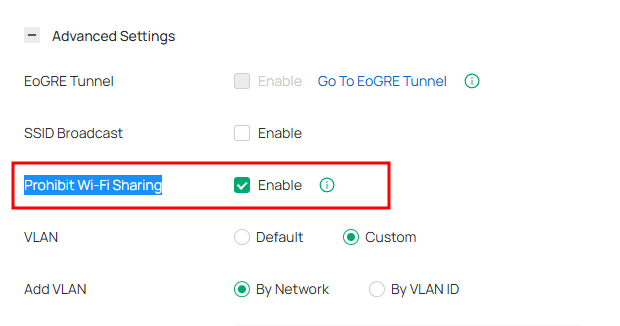
Turning on this function requires additional processing for all traffic, so it will indeed have a slight impact on performance. Please turn off Prohibit Wi-Fi Sharing, pause other traffic of this EAP, and test the speed for some more times. The performance should be fine.
Artur.Aragao wrote
Yes, I have the "Prohibit Wi-Fi Sharing" feature enabled. I started using it, but I feel like it's not just this feature that's limiting me.
I already maxed out at 500MB with a 700MB link a while ago. But, if I'm not mistaken, it was with an older firmware.
Regarding the "Prohibit Wi-Fi Sharing" feature, when I disabled it, the download and upload went from 223MB / 232MB to 265MB (at one point it reached 318MB) / 258MB, respectively. Still, for what I've had, it's low.
This feature is great and I can't see why it causes this anomaly.
Anyway, my dear. Thank you very much for your usual kindness.
- Copy Link
- Report Inappropriate Content
Thanks for the feedback. This is a good idea. You may start a new request post to gather more voters.
Artur.Aragao wrote
In order to improve the integrity of information for the user, it would be beneficial for TP-Link to highlight, in Omada products via a pop-up or informational message with warning indicators, features that may impact their availability. This is especially important in cases like this, where the provisioned feature clearly needs to be effective, unless it is a feature that, due to some eventuality in its functionality, could actually cause this, with the user being responsible for and aware of this and the choice they need to make.
This would significantly reduce the number of posts with these questions, unless they are real problems. And this helps to further consolidate the Omada environment, not only for us enthusiasts but for everyone in the ecosystem.
- Copy Link
- Report Inappropriate Content

Hello, can anyone who is using this beta firmware in standalone mode confirm if it fixes the constant spamming of "omada" DNS queries? Iv seen other threads mentioning the issue, but never really anyone that has fixed it other than "wait for a new firmware release".
- Copy Link
- Report Inappropriate Content
Hi @angrynerd
This beta firmware has not integrated that feature. It's still under development. Thanks.
angrynerd wrote
Hello, can anyone who is using this beta firmware in standalone mode confirm if it fixes the constant spamming of "omada" DNS queries? Iv seen other threads mentioning the issue, but never really anyone that has fixed it other than "wait for a new firmware release".
- Copy Link
- Report Inappropriate Content
I followed the procedure you requested. I disabled the feature on all WiFi profiles.
The speed now fluctuates between 220MB, 260MB, and 310MB. It doesn't go beyond that. It usually stays between 220MB and 260MB.
Something is definitely wrong. It should reach the maximum speed.
- Copy Link
- Report Inappropriate Content
I understand where the problem lies.
This test is being conducted on the 5.0GHz network. And it's with this network that I'm primarily identifying this strange situation.
NOTE: If other users are experiencing problems with the 2.4GHz network, it would be very helpful to point that out. I will conduct further tests to investigate this as well later.
The WLAN optimizer isn't working properly. That's what I used before, a while ago, and I didn't identify any problems.
However, reviewing it now, I noticed that the Channel Width setting was at 40Hz, when it should be at 160Hz. The TX Power setting was also low.
I decided to tweak it a bit and noticed that it improved with the manual settings, but it still doesn't reach the full access speed. I'm at 308Mbps ~ 422Mbps download / 230Mbps ~ 239Mbps upload. It's a significant improvement compared to what it was before. I noticed that the information is fluctuating a lot at the level I presented, but I understand that there may be particularities. However, it's not possible to understand the ineffective use of internet bandwidth.
Previously, DFS channels caused this type of problem, and looking at what the optimization applied, it maintained the DFS channels. I had disabled them, but I didn't notice any changes. Did TP-Link make any improvements to the DFS channels? The use of these channels was very unstable in the past, and now they are normal. At least, they appeared that way.
Certainly there is something that needs to be fixed with the next firmware. When I had the older firmware, prior to 1.3.0, this didn't happen.
- Copy Link
- Report Inappropriate Content
Thanks for the feedback.
In the new firmware, we have indeed implemented partial optimizations for DFS (Dynamic Frequency Selection) channels, enhancing stability and compatibility in the 5GHz band. In the past, DFS channels might have experienced fluctuations due to radar signal interference or regional regulatory restrictions. The current version has further improved the channel detection and switching mechanisms, which may explain why you are experiencing more stable DFS channel performance compared to before.
For the 5.0GHz network you are currently using, after manually adjusting the channel bandwidth to 160Hz, the speed test results show downloads ranging from 308Mbps to 422Mbps and uploads ranging from 230Mbps to 239Mbps. These results are in line with expectations for this bandwidth setting. Due to factors such as interference in the wireless environment, device protocol support, or terminal device performance, the actual speed may not fully reach the theoretical maximum. However, compared to previous results, there has been a significant improvement, indicating that the manual adjustments have been effective.
The WLAN optimization tool is designed to balance maximum wireless performance and network stability intelligently. Your previous observation that it set the channel bandwidth to 40Hz was not a malfunction but rather an automated decision made by the tool based on the real-time wireless environment at that time (such as surrounding interference levels, terminal device connection status, signal quality, etc.). In complex environments, higher bandwidths (such as 160Hz) can provide higher theoretical speeds but are also more susceptible to interference, potentially leading to unstable connections or speed fluctuations. To prioritize the stability and reliability of your network connection, the optimization tool may automatically opt for more conservative channel bandwidth settings.
Artur.Aragao wrote
I understand where the problem lies.
This test is being conducted on the 5.0GHz network. And it's with this network that I'm primarily identifying this strange situation.
NOTE: If other users are experiencing problems with the 2.4GHz network, it would be very helpful to point that out. I will conduct further tests to investigate this as well later.
The WLAN optimizer isn't working properly. That's what I used before, a while ago, and I didn't identify any problems.
However, reviewing it now, I noticed that the Channel Width setting was at 40Hz, when it should be at 160Hz. The TX Power setting was also low.
I decided to tweak it a bit and noticed that it improved with the manual settings, but it still doesn't reach the full access speed. I'm at 308Mbps ~ 422Mbps download / 230Mbps ~ 239Mbps upload. It's a significant improvement compared to what it was before. I noticed that the information is fluctuating a lot at the level I presented, but I understand that there may be particularities. However, it's not possible to understand the ineffective use of internet bandwidth.
Previously, DFS channels caused this type of problem, and looking at what the optimization applied, it maintained the DFS channels. I had disabled them, but I didn't notice any changes. Did TP-Link make any improvements to the DFS channels? The use of these channels was very unstable in the past, and now they are normal. At least, they appeared that way.
Certainly there is something that needs to be fixed with the next firmware. When I had the older firmware, prior to 1.3.0, this didn't happen.
- Copy Link
- Report Inappropriate Content

- Copy Link
- Report Inappropriate Content
@eblieb hopefully, but the v3 of both the 650 and 670 are getting more information on the US support site. Eg. The 670v3 had its data sheet and GPL posted within the last few days. Might not be related, but also not unreasonable to think that they are focusing on the new revisions at the moment.
- Copy Link
- Report Inappropriate Content
Information
Helpful: 1
Views: 13738
Replies: 74
Voters 0
No one has voted for it yet.