
SG3452P Repeatedly Disconnecting from Omada Cloud Controller
SG3452P Repeatedly Disconnecting from Omada Cloud Controller

Hi all,
We are experiencing a recurring issue across 10 sites where the SG3452P repeatedly goes into a heartbeat missing loop and disconnects from the Omada Cloud-Based Controller throughout the day and night, then reconnects automatically after 10 to 13 minutes. This cycle repeats indefinitely with no manual intervention.
Setup at each affected site:
- Switch: SG3452P V3.30, firmware 3.30.0 Build 20230818 Rel.73626
- Controller: Omada Cloud-Based Controller (CBC)
- Gateway: FortiGate FG40F
- APs: EAP613
Symptoms:
- Switch cycles between Heartbeat Missed, Disconnected, and Reconnected repeatedly all day
- Recovery time is consistently 10 to 13 minutes across every event
- APs at the same sites remain connected to the Cloud Controller throughout every event
- All client devices remain online and network traffic is unaffected during every event
- Switch responds to ping from the FortiGate during every disconnect event
What we have ruled out:
- Network path issue: switch is pingable throughout every event and APs stay connected on the same path
- ISP instability: confirmed via FortiGate, no WAN drops during events
- Firmware as a blanket issue: other sites running the same firmware and hardware have zero occurrences
Screenshot:
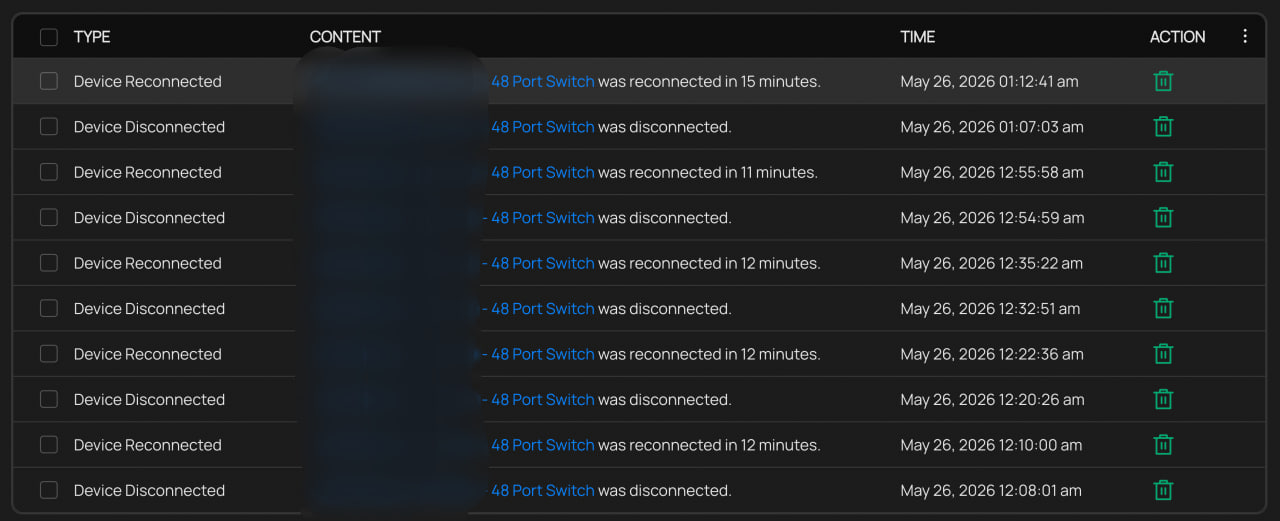
What we have found: As shown in the screenshot above, log analysis from one affected site over 7 days recorded 379 disconnect events averaging 54 per day. The consistent 10 to 13 minute recovery time across all events points to an internal management process crashing and restarting rather than a network-level issue.
The only consistent difference between affected and stable sites is wired client activity volume. Affected sites generate 2,000 to 5,500 wired client connection and disconnection events per day. Stable sites with the same switch, firmware, and topology generate approximately 40 to 44 per day. Affected sites are high-traffic retail environments with frequent device turnover throughout the day.
We also note that firmware versions 3.30.4 through 3.30.14 include fixes for abnormal spanning tree convergence under high client counts and adoption stability improvements. Our affected switches have not received any of these updates as they remain on the August 2023 build.
We are planning to test a firmware upgrade on one site and monitor results. Has anyone experienced something similar or found a resolution? Any input from TP-Link engineers would be appreciated.
- Copy Link
- Subscribe
- Bookmark
- Report Inappropriate Content


Hi @oewncj
Thanks for posting here.
All client devices remain online and network traffic is unaffected during every event
Affected sites generate 2,000 to 5,500 wired client connection and disconnection events per day.
These two statements seem somewhat contradictory. I want to confirm whether wired clients connected to the switch are affected during the switch’s heartbeat-miss period. The EAP is powered by the switch’s PoE, correct? Was the EAP's wireless network functioning normally when the problem occurred?
Are the gateways for all 10 affected sites FortiGate FG40F?
To confirm, is your controller cloud-based standard version, or the Essential version?
- Copy Link
- Report Inappropriate Content
Hello @Vincent-TP,
Thank you for your response. Kindly refer below for the answers to your inquiries:
1. I want to confirm whether wired clients connected to the switch are affected during the switch’s heartbeat-miss period.
> No, the wired clients that are connected to the switch is not affected during the switch’s heartbeat-miss. It’s able to browse and access to internet normally.
2. The EAP is powered by the switch’s PoE, correct?
> Correct, AP is powered by Switch PoE
3. Was the EAP's wireless network functioning normally when the problem occurred?
> Yes, EAP connected to the switch has no issues and remains to be in connected state as well.
4. Are the gateways for all 10 affected sites FortiGate FG40F?
> Yes, correct.
5. To confirm, is your controller cloud-based standard version, or the Essential version?
> We are using the standard version cloud controller.
I look forward to your assistance.
- Copy Link
- Report Inappropriate Content
Hi @oewncj
Thanks for the detailed reply.
One more question: when did you first notice this issue? During the initial occurrence of the issue, did you perform any operations? For example, did you upgrade the switch firmware or make any other configuration changes?
oewncj wrote
Hello @Vincent-TP,
Thank you for your response. Kindly refer below for the answers to your inquiries:
1. I want to confirm whether wired clients connected to the switch are affected during the switch’s heartbeat-miss period.
> No, the wired clients that are connected to the switch is not affected during the switch’s heartbeat-miss. It’s able to browse and access to internet normally.
2. The EAP is powered by the switch’s PoE, correct?
> Correct, AP is powered by Switch PoE
3. Was the EAP's wireless network functioning normally when the problem occurred?
> Yes, EAP connected to the switch has no issues and remains to be in connected state as well.
4. Are the gateways for all 10 affected sites FortiGate FG40F?
> Yes, correct.
5. To confirm, is your controller cloud-based standard version, or the Essential version?
> We are using the standard version cloud controller.
I look forward to your assistance.
- Copy Link
- Report Inappropriate Content
Hi @oewncj
I have also emailed your registered email address to collect the controller logs for further analysis, but I received a return message that the email was not sent.
Please send me a private message with one available email address, or contact the support team.
- Copy Link
- Report Inappropriate Content
Hello @Vincent-TP
When did you first notice this issue?
> We just noticed the issue this week, it went under our radar due to no complaints from these sites regarding connectivity issues. It seems that the event log per site only retains up to one week of logs. Kindly refer to the screenshot below:
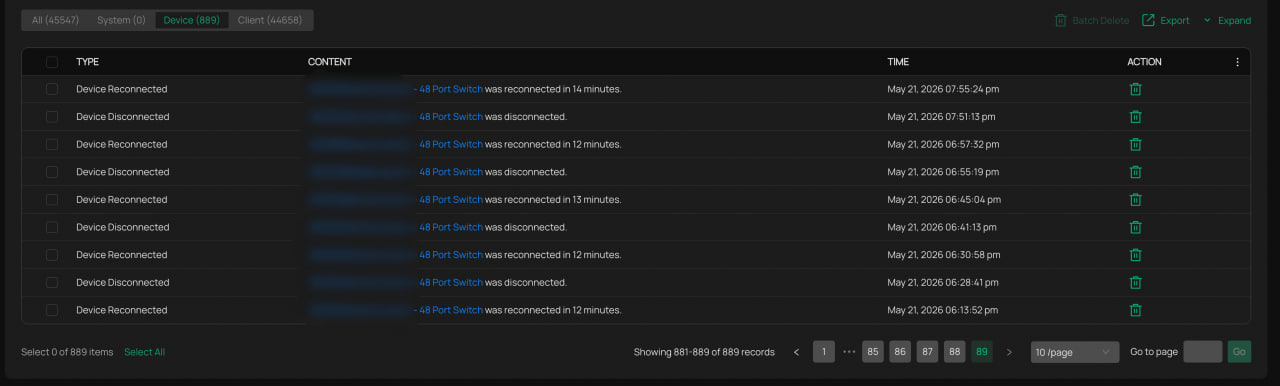
During the initial occurrence of the issue, did you perform any operations? For example, did you upgrade the switch firmware or make any other configuration changes?
> We did not make any firmware upgrades or configuration changes during initial occurences of the issue.
- Copy Link
- Report Inappropriate Content
Hi @oewncj
Thanks for the reply.
To better assist you, I've created a support ticket via your registered email address and escalated it to our support engineer to look into the issue. The ticket ID is TKID260581383. Please check your inbox and confirm that the support email was received. Thanks!
Once the issue is resolved, please update this thread with your solution to help others who may encounter the same problem.
Many thanks for your excellent cooperation and patience!
- Copy Link
- Report Inappropriate Content
Hi @oewncj
We noticed that your switch firmware is quite outdated, dating back to 2023. This behavior is similar to a known issue we had previously, which has since been resolved through a firmware update. Please follow the steps below to update:
- Temporarily reduce the WAN port MTU on the FortiGate (the default is usually 1500—you can set it to 1300). At this point, the switch should remain stably connected.
- Upgrade all switches to the latest version. https://support.omadanetworks.com/en/product/sg3452p/v3.30/?resourceType=download
- Restore the MTU value on the FortiGate.
Looking forward to your update. Thanks.
- Copy Link
- Report Inappropriate Content
Hello @Vincent-TP
We would like to proceed with the firmware upgrade however we have some concerns before doing so. The affected switches are currently running firmware 3.30.0 Build 20230818 Rel.73626, which is significantly behind the latest version. Given the large version gap spanning nearly 3 years worth of firmware releases, we want to understand the risks involved before proceeding. Specifically, we are concerned about the following:
- Are there any known risks or complications when upgrading directly from a firmware as old as 3.30.0 Build 20230818 to the latest version in a single step? Or would it be safer to upgrade through intermediate versions?
- Has there been any reported cases of switches becoming unmanageable, stuck in a disconnected state, or experiencing unexpected behavior after jumping from a significantly older firmware to the latest build?
- Will existing configuration be fully preserved after the upgrade, or is there any risk of configuration loss given the large version gap?
- Is upgrading through the Omada Cloud Controller safe for this scenario, or is on-site upgrade through the switch's local web interface recommended to avoid any risk of interruption?
We want to ensure the upgrade does not cause any unintended disruption to site operations. Any guidance on the safest approach would be greatly appreciated.
Looking forward to your response. Thank you.
- Copy Link
- Report Inappropriate Content
Hi @oewncj
Please see my answers below
oewncj wrote
Hello @Vincent-TP
We would like to proceed with the firmware upgrade however we have some concerns before doing so. The affected switches are currently running firmware 3.30.0 Build 20230818 Rel.73626, which is significantly behind the latest version. Given the large version gap spanning nearly 3 years worth of firmware releases, we want to understand the risks involved before proceeding. Specifically, we are concerned about the following:
- Are there any known risks or complications when upgrading directly from a firmware as old as 3.30.0 Build 20230818 to the latest version in a single step? Or would it be safer to upgrade through intermediate versions? When there is a significant span between versions, it is indeed possible for an upgrade to fail. You can try upgrading directly. If it works, it generally means you can always upgrade directly without needing intermediate firmware versions.
- Has there been any reported cases of switches becoming unmanageable, stuck in a disconnected state, or experiencing unexpected behavior after jumping from a significantly older firmware to the latest build? ---This situation does occur. Occasionally, there is feedback where the device fails to establish a connection with the controller after an upgrade. There are uncertain factors during the upgrade process, and we cannot guarantee a 100% success rate.
- Will existing configuration be fully preserved after the upgrade, or is there any risk of configuration loss given the large version gap?---The upgrade process will not result in the loss of configurations. After the upgrade is completed, the controller will reapply the existing configurations to the switch.
- Is upgrading through the Omada Cloud Controller safe for this scenario, or is on-site upgrade through the switch's local web interface recommended to avoid any risk of interruption?---Upgrading via CBC is possible, but it requires a stable network connection. Upgrading locally through the standalone interface can be more troublesome. For example, you would need to reset each switch individually and perform the operations on each device.
Upgrade issues are relatively rare; in the vast majority of cases, upgrades are completed successfully. You may upgrade these switches in batches and at different times. Additionally, once a device successfully completes an upgrade, it will automatically restart. During this period, the switch will inevitably experience network disconnection, so please schedule the upgrade appropriately. We also recommend performing the upgrade under stable network conditions. If possible, upgrading to an intermediate firmware version first is advisable.
Please note that due to the many uncertainties during the upgrade process, we cannot guarantee that all upgrades will be completed perfectly. For instance, the power supply must not be interrupted during the upgrade, and the network connection must remain stable when upgrading via CBC.
We want to ensure the upgrade does not cause any unintended disruption to site operations. Any guidance on the safest approach would be greatly appreciated.
Looking forward to your response. Thank you.
- Copy Link
- Report Inappropriate Content
Hi @Vincent-TP
Thank you for your response. We appreciate the clarification however we would like to dig deeper into the technical details as we are still trying to fully understand the root cause before proceeding with the upgrade.
We apologize for the lengthy and detailed inquiries. However, given that these are production sites serving active clients, we need to ensure that our operations are not interrupted and that we do not lose our client's trust. It is important for us to thoroughly understand the issue before proceeding with any fix.
To give you more context, we have other sites running the exact same switch model and firmware version 3.30.0 Build 20230818 that are working perfectly fine with no heartbeat missing issues. The key difference we have observed is that in the Logs > Events > Clients, the affected sites generate tens of thousands of client connection and disconnection events daily, while the healthy sites generate only 500 to 1000 at most. This suggests the issue may be load or activity related rather than a simple firmware defect affecting all devices equally.
With that in mind, we would like to ask the following:
- Have you seen similar cases from other clients where the heartbeat missing loop occurs specifically on high-traffic sites while low-traffic sites on the same firmware remain stable?
- What is the technical root cause of this issue? Is it a memory leak, a buffer overflow, or a processing limit within the management process that causes it to crash under high client activity?
- Which specific firmware version addressed this issue, and what exactly was changed or fixed in that version to resolve it?
- Is there a specific changelog entry or internal bug reference that documents this fix so we can confirm the exact build that resolved the problem?
Understanding the root cause and which firmware specifically fixed it will help us better assess the risk and justify the upgrade to our management. Thank you for your continued assistance. Looking forward to your assistance.
- Copy Link
- Report Inappropriate Content
Information
Helpful: 0
Views: 443
Replies: 11
Voters 0
No one has voted for it yet.